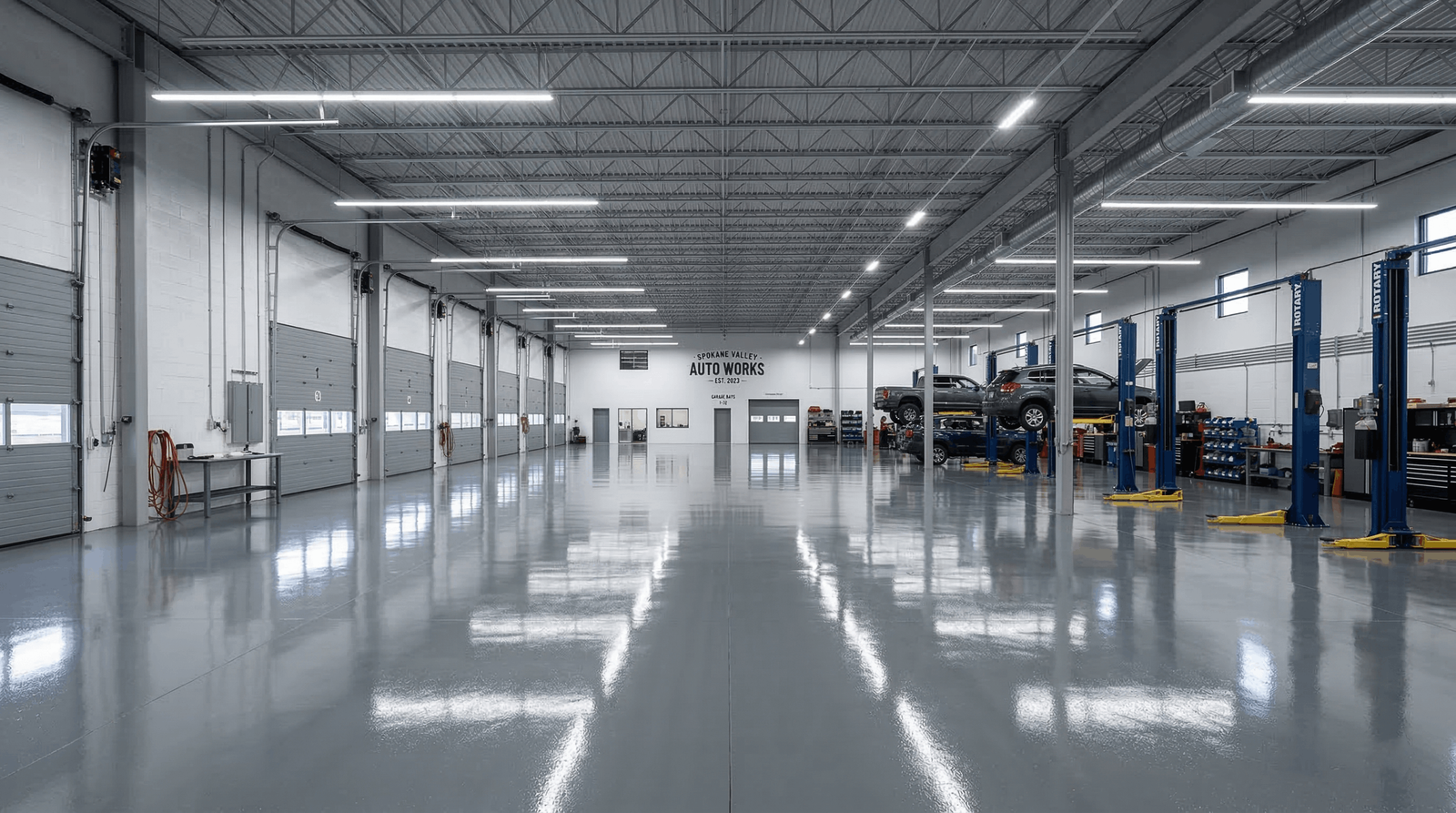
Warehouse Floor
Coatings
That Take Forklifts
Warehouse floor coatings built around hard-wheel traffic, joint edges and a building that never closes
A warehouse floor does not fail in the middle. It fails at the joints, at the dock edge, and in the two feet at the end of every aisle where a lift truck pivots. We specify warehouse floor coatings around those three places first, phase the work zone by zone, and put the return-to-service time in the contract instead of promising it on the phone.
Warehouse floor coatings live or die at the joint, not in the field
Walk any distribution building that is more than ten years old and the story is the same. Out in the open field the slab is fine. Then you get to a saw-cut joint and the concrete on both sides of it is chipped back an inch, the forklift bangs across it, the operator swings wide to avoid it, and the damage spreads sideways down the line. That is the problem warehouse floor coatings have to solve, and it is the one most bids never mention.
Joint edges fail because nothing is holding them up. A hard polyurethane or steel wheel crossing an unfilled saw cut lands its whole load on an unsupported corner of concrete. ACI 302.1R addresses this directly: fill contraction joints full depth with a semi-rigid filler in the region of Shore A 80, hard enough to carry the wheel across the gap and support the arris. A soft elastomeric sealant at Shore A 20 does not — the wheel pushes it down, the edge takes the hit, and you get exactly the spalling you were trying to prevent. That is one detail, it costs a few dollars a linear foot, and it decides how the whole floor ages.
The second failure is prep, and it is always the same shortcut. Acid etching leaves residue and an inconsistent profile. Mechanical profiling — diamond grinding or shot blasting to an ICRI CSP 2–3 surface — is the difference between a film that is bonded and a film resting on the slab. Nearly all the peeling warehouse floor coatings we are asked to replace were put down on an etched slab.
The third is film thickness, which nobody writes down. "High-build epoxy" is a category, not a specification. Without a stated wet and dry mil build per coat, an honest 30 mil quote loses every time to the same system applied at 10. Ask for mils in writing and watch how many bids change.
Warehouse Floor Coatings: Typical Main-Aisle Spec
Reference build- Joints first
- Saw cuts filled full depth, semi-rigid polyurea, ~Shore A 80, shaved flush
- Spalls & dock edges
- Saw-cut square, rebuilt in polyurea mortar before coating
- Surface prep
- Diamond grind or shot blast to CSP 2–3, HEPA shrouded
- Moisture
- ASTM F2170 RH probes, 24 hr equilibration; mitigation above 80% RH
- Primer
- 100% solids penetrating epoxy, 6–8 mil
- Body coat
- High-build 100% solids epoxy, 20–25 mil
- Topcoat
- Polyaspartic or aliphatic urethane, 6–10 mil
- Total build
- 30–40 mil nominal
- Aisle turns
- Extra broadcast and build at pivot points and dock approaches
- Markings
- Aisles, walkways, pallet positions and stop lines coated in
- Return to service
- Foot 6 hr · Forklift 24 hr (polyaspartic topcoat)
Warehouse floor coating options, cheapest to heaviest
Warehouse floor coatings come in six realistic tiers and they are not interchangeable. The mistake that costs money is not picking the wrong brand — it is buying a tier below what the traffic demands, then paying for the prep twice. Costs below are installed, including mechanical prep, on a slab in reasonable condition.
| System | Installed | Life under lift trucks | Downtime | Best fit |
|---|---|---|---|---|
| Densifier / penetrating sealer | $3.00–$4.00 | No film to wear through; re-treat every 5–10 years | 1 day, traffic same or next day | Dusting is the only complaint. Rack storage, unheated bays, budget years. |
| Floor paint (1-part or thin 2-part) | $3.00–$4.50 | 1–3 years in a traffic aisle | 1–2 days | Low-traffic storage, tenant turnover, pre-sale refresh, brightening a dark building. |
| Thin-film epoxy (8–12 mil) | $4.00–$5.50 | 3–5 years | 2–3 days plus 72 hr cure | Pallet-jack areas, mezzanines, pick modules, staging that never sees a counterbalance truck. |
| High-build epoxy (30–40 mil) | $5.50–$8.00 | 10–20 years, correctly specified | 3–5 days plus 72 hr to forklifts | Main aisles, dock areas, battery and charging rooms, anywhere hard wheels turn. |
| Epoxy + polyaspartic topcoat | $6.50–$9.50 | Same body life; topcoat recoat at 5–8 years | 1–2 days, forklifts back at 24 hr | Buildings that cannot close. The uptime premium, and usually worth it. |
| Urethane cement (1/4 in mortar) | $9.00–$14.00 | 15–20+ years | 2–3 days | Washdown bays, wet dock aprons, freezer and cooler transitions, thermal cycling. |
Slab condition moves these numbers more than product selection does. Joint filling, spall repair, oil removal and moisture mitigation are all priced separately because they are all optional — in the sense that you can skip them and watch the coating fail on schedule. Send us the building and we will tell you which tier the traffic actually needs: get a written spec.
Four jobs on a warehouse floor
Warehouse Epoxy Flooring
High build · Main aisles · Dock areas100% solids epoxy at 20–25 mil under a hard topcoat — the heaviest of the warehouse floor coatings we install, and the only tier that reliably survives a loaded counterbalance truck pivoting in the same spot ten thousand times a year. It is also the best resurfacing value on a rough or previously coated slab.
Warehouse Floor Painting
Budget tier · Turnover · Light trafficSometimes paint is the right answer: a lease turning over, a building going on the market, a storage bay nothing heavy ever enters. We will quote it with an honest service life attached rather than pretending a thin film is a forklift floor.
Striping & Line Marking
Coated in, not painted onAisles, pedestrian walkways, pallet positions, stop lines and keep-clear boxes laid into the coating system and locked under a clear topcoat, so the marking wears at the same rate as the floor instead of disappearing under the first season of traffic.
Joint & Slab Repair
Fix it before you coat itSemi-rigid joint filling, spall and dock-edge rebuilds, crack routing, curled slab grinding. Often the entire job — plenty of warehouse floors do not need warehouse floor coatings at all, they need their joints put right and their dust locked down.
The building does not close, so warehouse floor coatings go in around it
Nobody shuts a distribution center to paint the floor. So the question is never "how long does it take" — it is "how small a piece can you do at a time, and how fast can I put a lift truck back on it."
The answer to the first is a zone map drawn before we mobilize: which aisles come out of service on which nights, where containment goes, how product and racking move, and which doors stay live. The answer to the second is chemistry. Conventional epoxy wants 72 hours before hard wheels; a polyaspartic topcoat over the same epoxy body cuts that to about 24, and keeps curing in a cold building where epoxy has effectively stopped below roughly 50 °F. Most buildings we quote therefore come back in weekend-sized pieces: grind Friday night, joints and body coat Saturday, topcoat and stripe Sunday, forklifts Monday morning.
- Zone-by-zone phasing plan issued before mobilization
- Night, weekend and shutdown-window crews
- HEPA-shrouded grinding so dust stays out of open inventory
- Return-to-service milestones written into the scope
- Racking moved and reset, or the floor cut around it, by agreement
- Temporary marking and barricades while zones are curing
Hard wheels are a point load with torque, and they find every weakness
The tire on a warehouse lift truck is not a car tire. Press-on polyurethane and steel wheels do not deform, so the contact patch is small, the pressure is high, and when the truck turns in place it adds torque on top of it. That combination is what actually destroys warehouse floor coatings, and it destroys them in predictable places.
Aisle ends, where every truck pivots. Dock approaches, where the plate drops and the wheels hit a lip. Joint edges, covered above. Charging areas, where acid and water find the one pinhole. A thin film shears at the pivot points first — you can read the traffic pattern off a failed floor like a map — which is why we build those areas heavier rather than pricing the whole building at one number. Warehouse floor coatings never carry the load, incidentally: the slab does. Anyone selling you a film as a structural repair is selling you something else.
- Extra build and aggressive broadcast at pivot points and dock approaches
- Dock edges and leveler pits rebuilt before coating, not coated over
- Semi-rigid filler in every contraction joint that carries traffic
- Slip texture tuned per zone — aggressive at wet transitions, mild where scrubbers run
- Battery and charging rooms detailed for acid resistance and containment
Six things that separate durable floor coatings for warehouses from cheap ones
None of these are exotic. They are the line items that get deleted when a bid needs to come down, and deleting them is why the warehouse floor coatings you are replacing failed.
We price the joints before the field
Linear feet of saw cut, condition of each arris, filler hardness and depth. On a lot of buildings the joint work is a third of the scope, and it is the third that decides whether the coating is still intact in year eight.
We test the slab before quoting
ASTM F2170 relative humidity probes with a 24-hour equilibration under the current revision, a pull-off adhesion test on any existing coating, and a look at where the oil has soaked in. Moisture is measurable a day in advance. Ignoring it is a choice.
Mechanical prep, never acid etch
Diamond grinding or shot blasting to an ICRI CSP 2–3 profile under vacuum shrouds, so we can work a hundred feet from open pick faces without dusting the inventory.
Mil thickness in the contract
Wet and dry film build stated per coat and checked with a comb gauge while the coat is wet, which is the only moment the number can be verified at all. It is also the only honest way to compare two bids for warehouse floor coatings.
Five chemistries of warehouse floor coatings, not one
Epoxy, polyaspartic, urethane cement, methyl methacrylate for cold rooms, densifiers for dust-only jobs. A contractor who installs one product will recommend that product for your freezer, because it is that or lose the job.
Backed by a real contractor
Warehouse Floor Coatings is a service of Crimbo Coatings — licensed, insured, Google Guaranteed, a Sherwin-Williams certified installer with manufacturer-backed warranty coverage, and Best of Bonner County 2026.
Industrial warehouse flooring, by what happens in the building
Racked storage, a 24/7 fulfillment operation and a −10 °F freezer are three different floors with three different failure modes. These pages get specific about the warehouse floor coatings each one needs.
Distribution & Fulfillment
High-cycle aisles, conveyor footings, AMR travel paths, mezzanines and returns areas.
FacilityCold Storage & Freezer
Coating a room that never gets above freezing, condensation at door lines, thermal cycling.
GuidePolished Concrete vs Epoxy
An honest comparison for warehouses, including when polishing is the better buy.
GuideEpoxy Floor Maintenance
Scrubber pads, pH-neutral cleaners and recoating the topcoat before the body wears through.
Warehouse floor coatings, answered
Warehouse floor coatings run between about $3 and $14 per square foot installed, and the spread is real rather than sales positioning. A densifier or a coat of floor paint on sound concrete is $3 to $4.50. A high-build epoxy system for main aisles is $5.50 to $8. Adding a polyaspartic topcoat to get forklifts back in 24 hours is $6.50 to $9.50. Urethane cement mortar for washdown and freezer transitions is $9 to $14. On a 200,000 sq ft building the decision that moves the number most is which zones genuinely need the heavy system and which can take a lighter one.
Yes, and it is how most warehouse floor coatings get installed. We zone the building, take aisles out of service on nights and weekends, contain the grinding dust with HEPA-shrouded equipment, and put forklifts back on a polyaspartic-topcoated zone at roughly 24 hours. What it requires from you is a decision about racking: product has to move out of the zone, and if the racking itself cannot move we coat up to the base plates and treat the rack footprint as excluded. Agree that before anyone quotes, because it changes both the price and the finished look.
A correctly specified 30 to 40 mil epoxy system in a main aisle should give ten to twenty years, with the topcoat recoated once or twice in that window. Thin-film epoxy at 8 to 12 mil gives three to five years. Ordinary floor paint in a traffic aisle gives one to three. Those numbers assume the joints were filled and the slab was dry — skip either and the life expectancy of any of them drops to whatever the first failure point decides.
Yes. Dusting comes from a weak, porous surface layer that traffic abrades into powder, and it lands on cartons, on racking and in equipment. A lithium or sodium silicate densifier reacts with free lime in the slab to harden that layer, which is the cheap answer when dust is the only complaint; a film-forming coating seals it outright and gives you a cleanable surface as well. If dusting is genuinely the whole problem we will say so and quote the densifier, at a fraction of the cost.
In any aisle that carries lift trucks, yes. An unfilled or softly sealed contraction joint leaves the concrete edge unsupported, and a hard wheel crossing it chips that edge back until the joint becomes a trench. ACI 302.1R calls for filling contraction joints full depth with a semi-rigid material around Shore A 80, so the filler carries the wheel and supports the arris. Filling is best done as late as practical after a slab is placed, once most drying shrinkage has happened.
Usually, and it is the cheapest route to a new floor. Sound, well-bonded epoxy gets mechanically abraded to profile and recoated. What cannot be recoated is a film that is already delaminating, one sitting over a slab that is pushing moisture, or one saturated with hydraulic oil — recoating any of those buys the same failure a year later at your expense. We pull-test previously coated slabs per ASTM D7234 before we quote, and we will tell you plainly when removal is the honest answer.
Barely. Warehouse floor coatings at 30 to 40 mil are about thirty-five thousandths of an inch thick, and the film follows whatever the slab already does — it will not correct a floor that misses its FF/FL targets under ASTM E1155, and will not ruin one that meets them. What it genuinely affects is surface texture and reflectivity, which can matter to optical navigation. Narrow-aisle and AGV facilities are commonly specified in the FF 35–50 range with F-min called out for defined travel paths, but check the number your vendor requires rather than a rule of thumb from a coatings contractor.
We take national enquiries and we quote them. How the work gets delivered depends on the building — size, timeline and where it is — and we would rather have that conversation honestly at the assessment stage than imply a branch office in every metro. Tell us where the building is and what the schedule looks like and you will get a straight answer about how, and by whom, it would be installed.
Sixteen more on cure schedules, striping colors, cold rooms, scrubbers and bid comparison in the full warehouse floor coatings FAQ.
Send us the building. We will send back a spec.
Square footage, what drives on it, how many hours a zone can be offline, and a photo of your worst joint. You will get a written warehouse floor coatings recommendation with mil thickness, joint detail, phasing and a real number — at no cost.